Porting a TempleOS program
This page ports a real TempleOS program to hcc and SDL2: Demo/Graphics/Bounce.HC from the TempleOS source. It's 47 lines: sixteen points, one per palette color, bounce around a window and leave trails. TempleOS is public domain, so the original is reproduced in full.
The port is examples/templeos-bounce/bounce.HC. It builds with the other examples and is checked by check.sh.
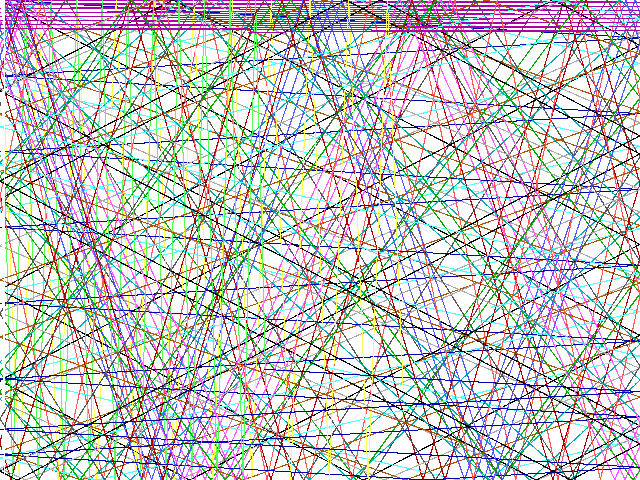
The original
TempleOS stores source in code page 437, not UTF-8. It's converted here so Θ and π display, but the bytes on disk are 0xE9 and 0xE3. The first line is a DolDoc hyperlink, which TempleOS's editor shows as a link to its fixed-point lecture.
//Uses $LK,"fixed-point-arithmetic",A="FI:::/Demo/Lectures/FixedPoint.HC"$.

I64 x[16],y[16],dx[16],dy[16];

U0 Init()
{
  I64 i;
  F64 Θ;
  MemSet(x,0,sizeof(x));
  MemSet(y,0,sizeof(y));
  for (i=0;i<16;i++) {
    Θ=Rand*2*π;
    dx[i]=I32_MAX*Cos(Θ);
    dy[i]=I32_MAX*Sin(Θ);
  }
}

U0 Bounce()
{
  CDC *dc=DCAlias;
  I64 i,ch;
  Init;
  try {//Catch <CTRL-ALT-c>
    do {
      for (i=0;i<16;i++) {
        dc->color=i;
        GrPlot(dc,x[i].i32[1],y[i].i32[1]);
        x[i]+=dx[i];
        y[i]+=dy[i];
        if (!(0<=x[i]<Fs->pix_width<<32)) {
          x[i]-=dx[i];
          dx[i]=-dx[i];
        }
        if (!(0<=y[i]<Fs->pix_height<<32)) {
          y[i]-=dy[i];
          dy[i]=-dy[i];
        }
      }
      Yield;
    } while (!(ch=ScanChar) || (ch!=CH_SHIFT_ESC && ch!=CH_ESC));
  } catch
    PutExcept;
  DCFill(dc);
  DCDel(dc);
}

Bounce;
The port
bounce.HC
// TempleOS's Demo/Graphics/Bounce.HC, ported to hcc and SDL2. Sixteen
// points, one per palette color, bounce around the window and leave
// trails. docs/templeos-porting.md goes through every change.
//
//   ./bounce              open a window; Esc quits
//   ./bounce --ppm a.ppm  run 20000 steps with no window and save the result

#include "../common/canvas.HC"
#include "../common/sdl2.HC"
#include "../common/screen.HC"

#define WIDTH  640
#define HEIGHT 480

#define I32_MAX 0x7FFFFFFF
#define PI      3.14159265358979

// The original moves every point once per Yield, which runs as fast as
// the scheduler allows. Here the window shows a frame every 1/60 s, so
// each frame takes several steps.
#define STEPS_PER_FRAME 32

// TempleOS's gr_palette_std, indexed by its color constants: BLACK, BLUE,
// GREEN, CYAN, RED, PURPLE, BROWN, LTGRAY, DKGRAY, LTBLUE, LTGREEN,
// LTCYAN, LTRED, LTPURPLE, YELLOW, WHITE.
U32 g_palette[16] = {
  0xFF000000, 0xFF0000AA, 0xFF00AA00, 0xFF00AAAA,
  0xFFAA0000, 0xFFAA00AA, 0xFFAA5500, 0xFFAAAAAA,
  0xFF555555, 0xFF5555FF, 0xFF55FF55, 0xFF55FFFF,
  0xFFFF5555, 0xFFFF55FF, 0xFFFFFF55, 0xFFFFFFFF,
};

// Positions are 32.32 fixed point: the pixel is the top 32 bits.
I64 x[16];
I64 y[16];
I64 dx[16];
I64 dy[16];

// Seeded in Init rather than here: see "Initialised globals and Main's
// arguments" in docs/compiler-quirks.md.
U64 g_seed;

// TempleOS's Rand returns an F64 in [0, 1). hcc has none, so this is a
// small generator with a fixed seed: every run draws the same pattern.
// The mask keeps the top 53 bits positive; see "Unsigned 64-bit shifts
// and conversions" in docs/compiler-quirks.md.
F64 Rand()
{
  g_seed = g_seed * 6364136223846793005 + 1442695040888963407;
  F64 r = (g_seed >> 11) & 0x1FFFFFFFFFFFFF;
  return r / 9007199254740992.0;
}

U0 Init()
{
  I64 i;
  F64 angle;
  g_seed = 1;
  MemSet(x, 0, sizeof(x));
  MemSet(y, 0, sizeof(y));
  for (i = 0; i < 16; i++) {
    angle = Rand() * 2 * PI;
    dx[i] = I32_MAX * cos(angle);
    dy[i] = I32_MAX * sin(angle);
  }
}

U0 Step(Canvas *c)
{
  I64 i;
  for (i = 0; i < 16; i++) {
    CanvasPixel(c, x[i] >> 32, y[i] >> 32, g_palette[i]);
    x[i] += dx[i];
    y[i] += dy[i];
    if (!(0 <= x[i] < c->width << 32)) {
      x[i] -= dx[i];
      dx[i] = -dx[i];
    }
    if (!(0 <= y[i] < c->height << 32)) {
      y[i] -= dy[i];
      dy[i] = -dy[i];
    }
  }
}

I32 RenderToFile(U8 *path)
{
  Canvas c;
  if (!CanvasInit(&c, WIDTH, HEIGHT)) {
    "out of memory\n";
    return 1;
  }
  CanvasClear(&c, g_palette[15]);
  for (I64 n = 0; n < 20000; n++)
    Step(&c);
  Bool ok = CanvasSavePpm(&c, path);
  CanvasFree(&c);
  if (!ok) {
    "could not write %s\n", path;
    return 1;
  }
  "wrote %s\n", path;
  return 0;
}

I32 Main(I32 argc, U8 **argv)
{
  Init;
  if (argc > 2 && !StrCmp(argv[1], "--ppm"))
    return RenderToFile(argv[2]);

  Screen screen;
  if (!ScreenOpen(&screen, "Bounce", WIDTH, HEIGHT, 1))
    return 1;

  // A TempleOS window's document is white, and DCAlias draws on top of it
  // without ever clearing, which is what leaves the trails.
  CanvasClear(&screen.canvas, g_palette[15]);
  while (SdlPumpEvents() && !SdlKeyDown(SC_ESCAPE)) {
    for (I64 n = 0; n < STEPS_PER_FRAME; n++)
      Step(&screen.canvas);
    ScreenPresent(&screen);
  }

  ScreenClose(&screen);
  return 0;
}
What changed
Where the pixels go
DCAlias returns a device context that draws straight onto the current window, on top of its document. Nothing clears it, so every GrPlot stays on screen, and that's what draws the trails. When the loop ends, DCFill(dc) with no colour fills it with TRANSPARENT, and the trails disappear.
The port draws into the canvas that screen.HC shows. The canvas is cleared to white once, the colour of a TempleOS window's document, and never again, so the trails survive. ScreenClose replaces DCFill and DCDel. Fs->pix_width and Fs->pix_height, the window's size, become c->width and c->height.
Colours
dc->color=i picks one of TempleOS's 16 palette colours by index. The canvas takes 32-bit colours, so the port copies TempleOS's standard palette (gr_palette_std in Adam/Gr/GrPalette.HC) into a table and indexes that:
The table is in the order of TempleOS's colour constants, so g_palette[RED] works if you also copy their values (BLACK is 0, through WHITE, 15).
Fixed point
Positions are 32.32 fixed point, and the original reads the whole-pixel part with x[i].i32[1]: the upper half of the I64, viewed as an I32. That sub-integer access is a TempleOS feature. hcc reports Expected as class however got integer type. A shift does the same thing:
Missing names
hcc's runtime is much smaller than TempleOS's, and its lexer only accepts ASCII names:
| Original | Port |
|---|---|
F64 Θ |
F64 angle |
π |
#define PI 3.14159265358979 |
I32_MAX |
#define I32_MAX 0x7FFFFFFF |
Cos, Sin |
cos, sin |
Rand |
a 64-bit LCG returning an F64 in [0, 1), with a fixed seed |
The Rand replacement masks its shifted state before converting it, because of an hcc bug: >> on a U64 copies the sign bit. Without the mask, half the values come out negative.
Calls without parentheses
HolyC lets you call a function with no arguments without the parentheses, and hcc supports it: Init; is unchanged in the port. Inside a float expression it isn't supported. Θ=Rand*2*π; fails the build with Binop has returned null type, so the port writes Rand().
One global per line
I64 x[16],y[16],dx[16],dy[16]; is four globals in one declaration, which hcc can't parse. The port declares them on four lines.
The loop
The original runs as fast as the scheduler lets it. Each pass through the loop moves every point once and then calls Yield, which gives other tasks a turn. ScanChar returns a character if one was typed, and the loop stops on Esc or Shift-Esc. try/catch exists so Ctrl+Alt+C, TempleOS's break key, still runs the cleanup after it.
The port uses the frame loop every example here uses. It pumps SDL's events, checks Esc with SdlKeyDown, runs STEPS_PER_FRAME steps, then presents one frame. hcc accepts try/catch, but there's no break key to catch, so it's gone. The original's speed depends on the machine; the port's is fixed by the frame rate and STEPS_PER_FRAME.
The entry point
A TempleOS file runs top to bottom when it's included, and Bounce; on the last line starts it. hcc runs top-level statements too, but every example here uses I32 Main() so it can take arguments: --ppm runs 20,000 steps with no window and saves the image, which is how check.sh tests the port and how the screenshot above was made.
What carried over
More than you might expect:
- Range comparisons.
if (!(0<=x[i]<Fs->pix_width<<32))means "outside [0, width)" in TempleOS, and means the same in hcc. In C it would compare a 0-or-1 result against the width and always be true. - Calls without parentheses outside expressions, like
Init;. MemSet(x,0,sizeof(x))on a global array.dx[i]=-dx[i]. hcc has a bug negating an indexed value, but it only affects expressions with more after the negated term.- The
"..."print statement, default arguments, and the HolyC types.
Porting other programs
The TempleOS graphics calls that have a direct equivalent here. Signatures are from TempleOS's Adam/Gr sources.
| TempleOS | This guide |
|---|---|
Fs->draw_it=&DrawIt; |
call DrawIt(&screen.canvas) each frame, before ScreenPresent |
dc->color=RED; |
pass a colour to each call; Rgb(170, 0, 0) is TempleOS's red |
GrPlot(dc,x,y) |
CanvasPixel(c, x, y, color) |
GrLine(dc,x1,y1,x2,y2) |
CanvasLine(c, x1, y1, x2, y2, color) |
GrRect(dc,x,y,w,h) (filled) |
CanvasFillRect(c, x, y, w, h, color) |
GrBorder(dc,x1,y1,x2,y2) (outline, corners) |
CanvasRect(c, x1, y1, x2 - x1 + 1, y2 - y1 + 1, color) |
GrFillCircle(dc,cx,cy,0,diameter) |
CanvasFillCircle(c, cx, cy, diameter / 2, color) |
GrCircle(dc,cx,cy,radius) (outline) |
no equivalent yet; write a midpoint circle |
GrPrint(dc,x,y,fmt,...) |
StrPrint into a buffer, then FontDrawText |
DCFill(dc), DCClear(dc) |
CanvasClear(c, color) |
sprites in $SP$ entries, Sprite3 |
ASCII-art sprites, or export to PNG and load it |
ScanChar, GetKey |
SdlKeyDown with the previous frame's state, as in Input |
Bt(kbd.down_bitmap,sc) |
SdlKeyDown(scancode) |
Sleep(ms) |
SDL_Delay(ms), or let the frame loop's vsync set the pace |
Two differences cut across all of these. TempleOS's font is 8x8 and has lowercase; font.HC is 5x7 uppercase. TempleOS scan codes are PC keyboard codes, while SDL's are USB codes, so translate keys by name (SC_CURSOR_LEFT becomes SC_LEFT), not by number.